The Collection
Humans in the Age of Intelligence Explosion
What stays human as machines become intelligent?
The collection is a walk-through argument about the transition we’re living through. Each work occupies a position along a spectrum from the irreducibly human to pure machine intelligence, and the home itself becomes the exhibition — the architecture, poured concrete and shifting natural light, is the first work in the show.
Every piece shares one language: Lo-Fi — the compression of complex natural phenomena into reduced, meditative forms through slow human labor. A machine could render a perfect gradient, a perfect flame, a perfect flock. The hand’s imperfection — the uneven weave, the irregular burn — is what makes the work breathe. It signals that a human was here, slowly, for a long time.
That thread runs deeper than style. Weaving is arguably the oldest human technology: the loom is the original algorithm, warp and weft, binary up-and-down. Jacquard’s programmable loom inspired Babbage, who inspired Turing. The weave begat the pixel; the hand begat the algorithm. Every piece here sits somewhere on a twelve-thousand-year line from the first woven thread to the last autonomous machine.
Four Positions
- 1
Subjective experience
What can only be experienced, never computed?
- 2
Human craft within machine material
Where does the hand still matter?
- 3
Nature's algorithms made visible
Are we building intelligence, or discovering it?
- 4
Pure machine intelligence
What does the machine see without us?
Currently in the Collection
Studio Drift
Position 3Franchise Freedom · Kinetic light installation
A chandelier that mimics the murmuration of a starling flock — autonomous elements following emergent flocking rules, based on ten years of research. Nature's algorithm, made visible above the living space.
Kwon Yongrae
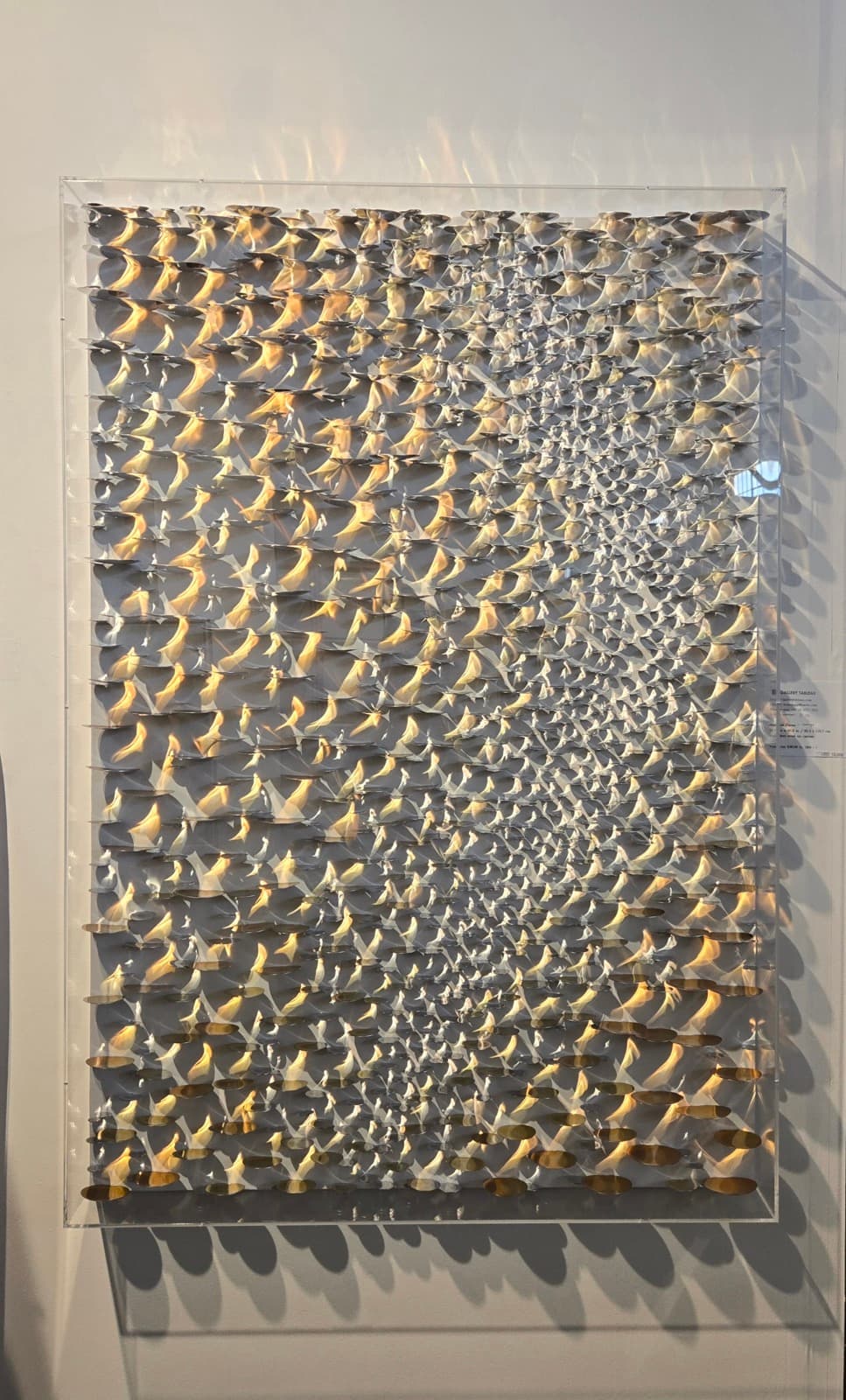
Position 2Eternal Flame, 2025 · Welded stainless steel on canvas
Hundreds of stainless steel units meticulously assembled by hand; the welding flame leaves calligraphic traces on the metal. An ancient metalworking process rendered as painting — the hand literally burned into an industrial surface.
Suzanne Frazier
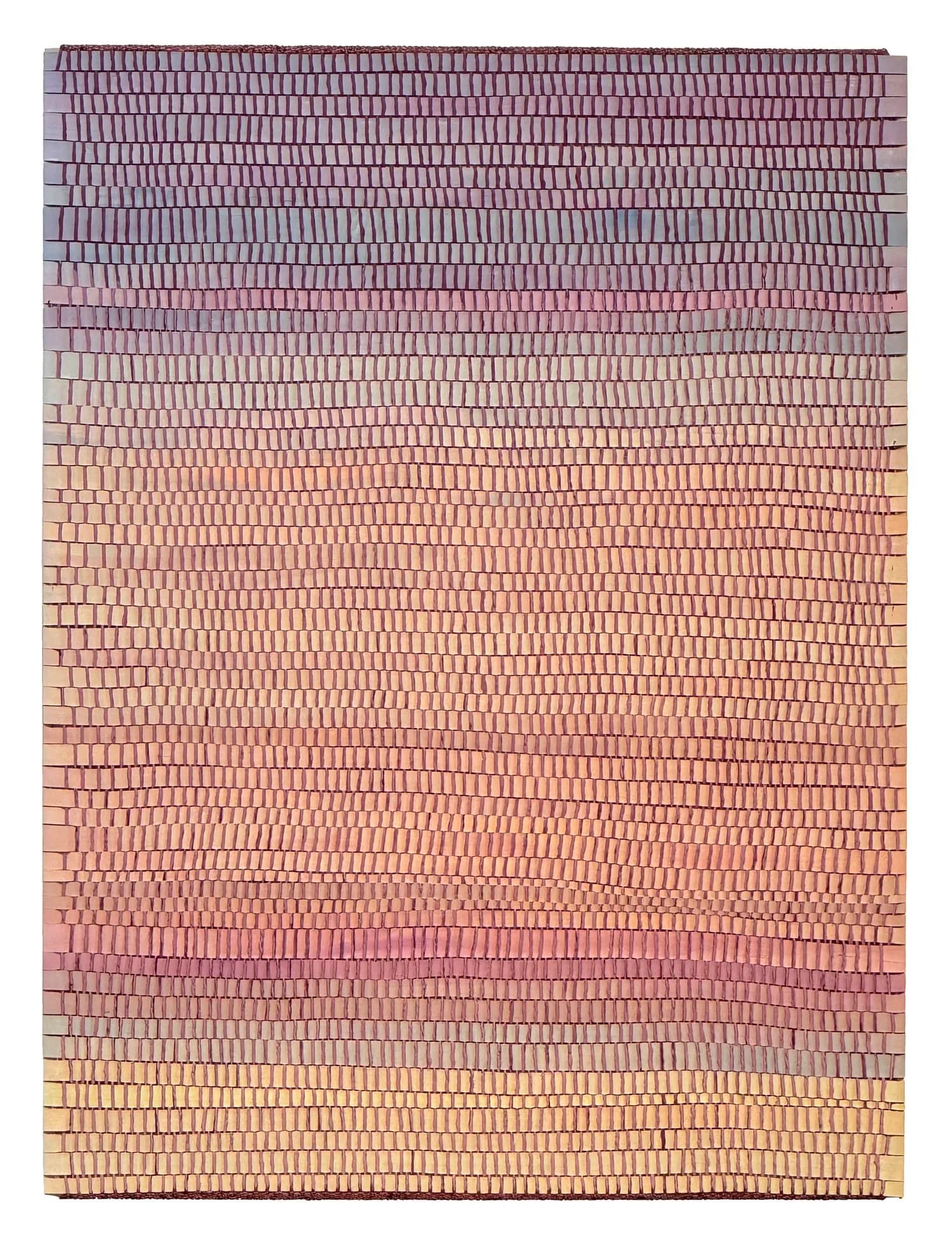
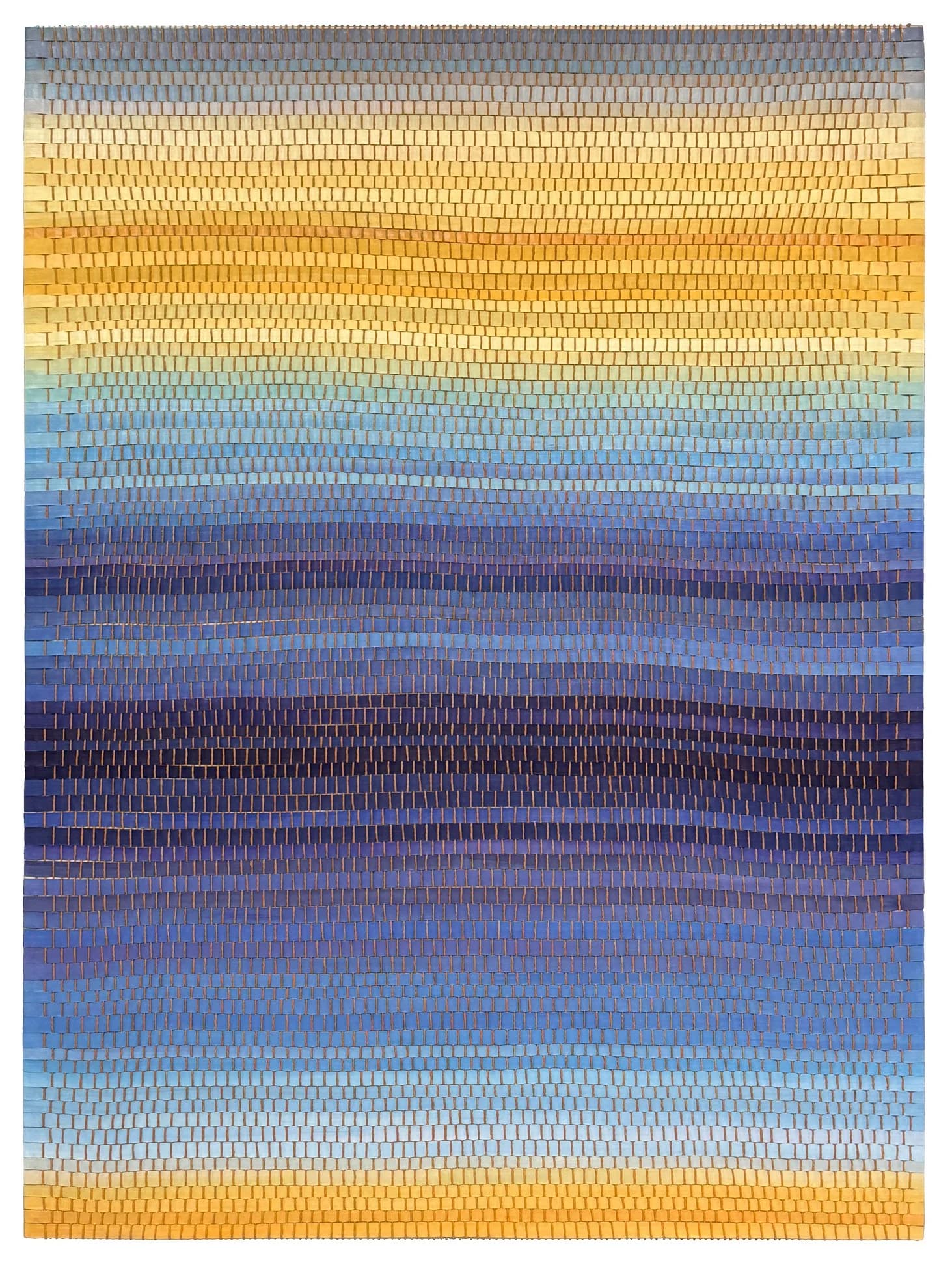
Position 2Gradient 2 & Gradient 4 · Hand-woven textile
Landscape gradients compressed into hand-woven pixel grids. The loom is the original algorithm — warp and weft, binary up-and-down — and weaving is arguably the technology from which computing descends. The collection's origin story.
Notes
- Weaving was the first programmable machine. In 1805 Joseph-Marie Jacquard drove a loom with punched cards — a hole or no hole, read row by row. A pattern was drawn on grid paper, then punched into cards: the first images stored as data.¹
- Ada Lovelace saw the lineage exactly: “the Analytical Engine weaves algebraic patterns just as the Jacquard loom weaves flowers and leaves.” Babbage's engine inherited the loom's punched cards, and so did Hollerith's tabulators and early IBM — computing ran on woven logic for a century.
- Frazier hand-weaves the same warp-and-weft binary that became the pixel. Each thread is a bit; the whole cloth is an image rendered with no machine at all — the origin of computing performed by the hand computing tried to replace.
- The weavers displaced by the loom threw their wooden shoes — sabots — into the gears. That gave us the word sabotage. The quarrel between the hand and the machine is two centuries old, and this collection is still having it.
Keira Kotler
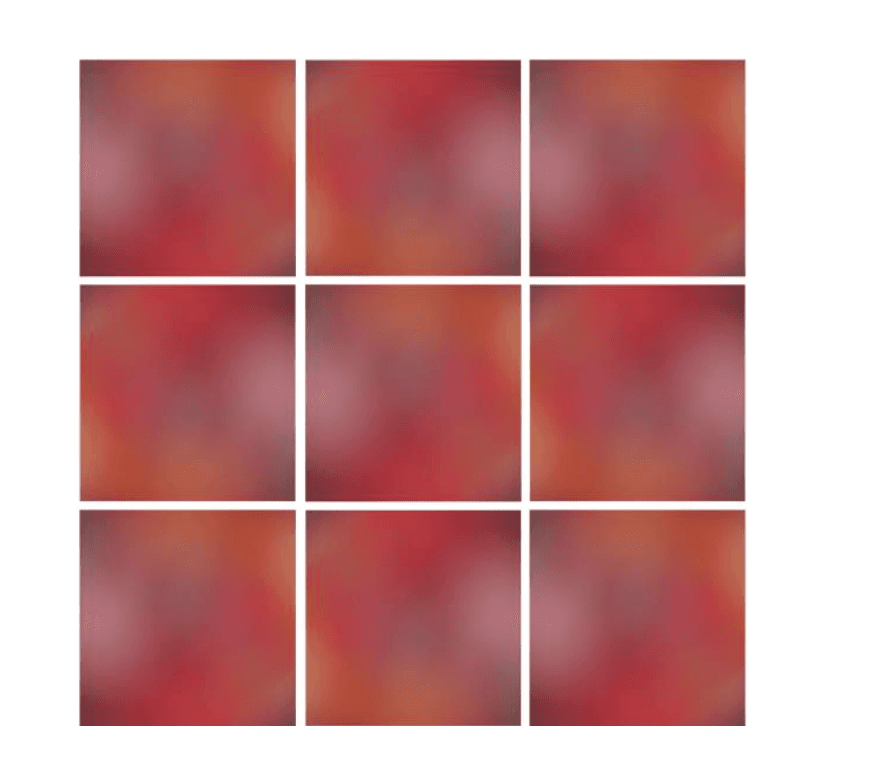
Position 1 → 3Between the Sea & Sky, 2021 · Nine pigment prints on aluminum
Sea and sky dissolved into pure color fields across a three-by-three aluminum grid — abstracted landscape given structure by the machine's logic while remaining, at heart, an experience of light.
A growing collection. New acquisitions are added as the argument deepens.
References
- 1.“A history of the Jacquard loom,” Science and Industry Museum. blog.scienceandindustrymuseum.org.uk/jacquard-loom